BLI — Bangash Legal Insights
A publication of Bangash & Co.
The Jurisprudence of Trademark Law in Pakistan
From Registration to Reputation: Deceptive Similarity, Passing Off, Trade Dress, Well-Known Marks and the Judicial Protection of Brand Identity
By Bangash & Co. — Advocates and Legal Consultants
Introduction
A trademark is much more than a name, word, logo or symbol. In commercial life, a trademark embodies the identity, reputation, goodwill and source-association of a business. Consumers often do not purchase a product merely because of its physical characteristics; they purchase it because they associate a particular name, appearance, packaging or presentation with a particular commercial source.
This is why trademark jurisprudence has consistently refused to reduce infringement to a mechanical comparison of letters.
The central question in a trademark dispute is frequently not:
Are the two marks exactly identical?
Rather, it is:
Would the use of the competing mark, packaging or overall presentation create a likelihood of deception, confusion or association in the mind of the relevant consumer?
The jurisprudence of Pakistani courts demonstrates a gradual movement from a narrow conception of trademark protection towards a broader protection of commercial identity and market reputation. Courts have considered phonetic similarity, visual appearance, the nature of goods, purchasing conditions, consumer sophistication, packaging, colour schemes, get-up, goodwill, prior use, disclaimers, territorial limitations and the surrounding circumstances.
At the same time, the courts have repeatedly emphasized that trademark protection does not confer an unrestricted monopoly over ordinary words. The law protects the distinctive commercial significance acquired by a mark, rather than ownership of language itself.
The result is a body of jurisprudence in which registration, use and reputation operate together, but perform different legal functions.
I. The Statutory Foundation of Trademark Protection
The principal statutory framework is the Trade Marks Ordinance, 2001, supplemented by the Trade Marks Rules, 2004, while the institutional and jurisdictional framework is also affected by the Intellectual Property Organization of Pakistan Act, 2012.
The Ordinance establishes the Trade Marks Registry and the Register of Trade Marks. Section 10 provides for recording registered marks together with matters such as proprietorship, assignments, transmissions, licences, disclaimers, conditions and limitations.
The Ordinance distinguishes between:
- the right arising from registration;
- infringement of a registered trademark;
- limitations and defences to infringement;
- passing off;
- disclaimers;
- invalidity and rectification;
- renewal and restoration; and
- protection of marks having particular reputation.
Section 40 is particularly important because infringement is not confined to situations where two marks are literally identical. The provision addresses identical and deceptively similar marks and incorporates the concept of likelihood of confusion, including likelihood of association, in appropriate circumstances.
This statutory structure provides the foundation upon which Pakistani courts have developed the jurisprudence discussed below.
II. Trademark Registration in Pakistan: From Application to Registration
Trademark litigation cannot be properly understood without understanding the registration process.
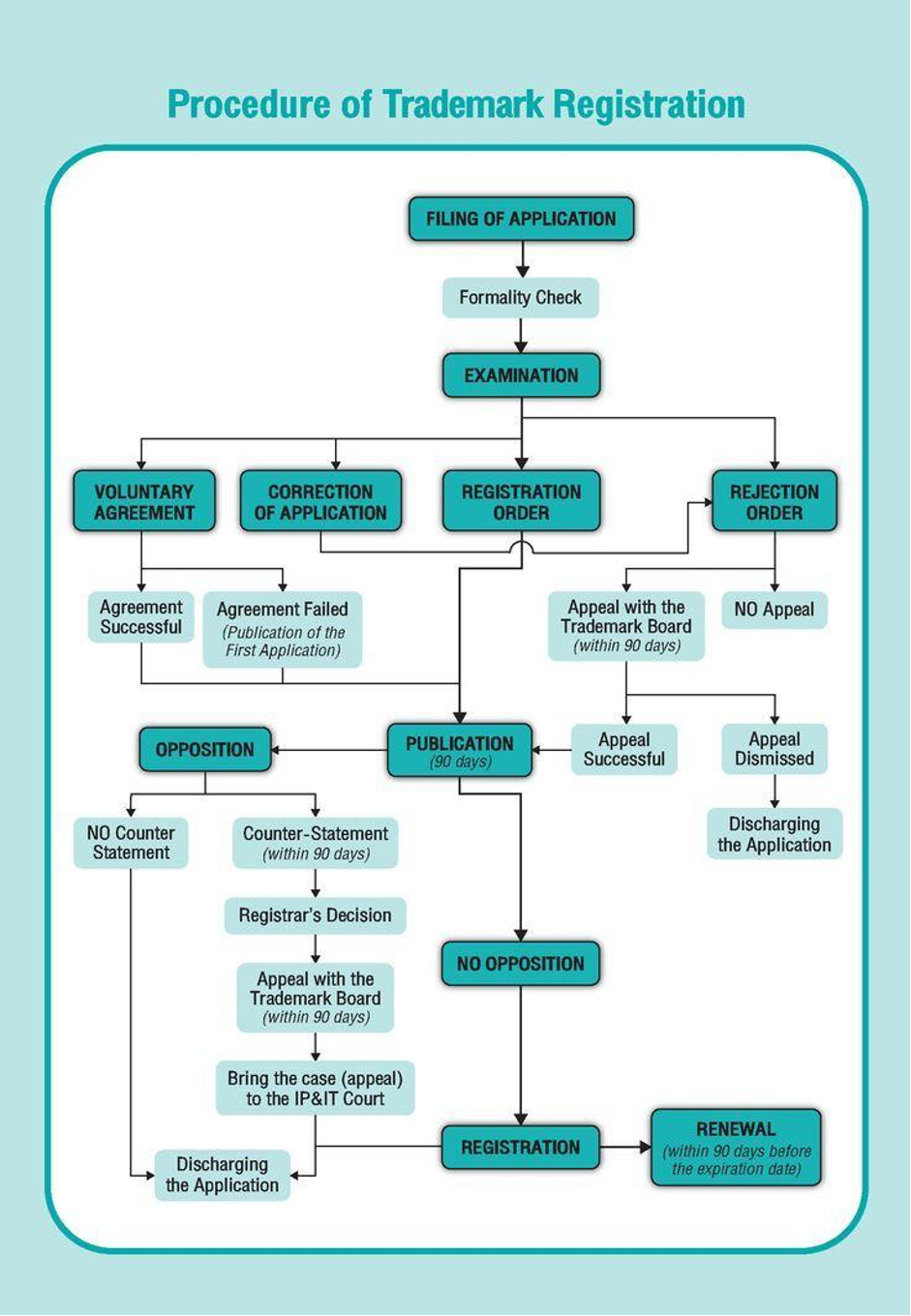
The accompanying registration-process chart illustrates the principal stages of trademark registration before the Trade Marks Registry.
- Trademark search
Before filing, an applicant should determine whether an identical or deceptively similar mark already exists.
A search is not merely an administrative convenience. It is an important part of risk management because a mark that appears distinctive to the applicant may already conflict with an earlier registration or application.
The Trade Marks Rules provide for applications and searches through prescribed forms, including Form TM-1 for an application and Form TM-55 for a search. The Rules classify goods and services according to the prescribed classification system.
- Filing of application
An application for registration is ordinarily made in the prescribed form and accompanied by the applicable fee. Under Rule 12 of the Trade Marks Rules, 2004, an application for goods or services falling within a particular class is made through Form TM-1.
- Examination
The Registrar examines the application to determine whether the mark satisfies the statutory requirements.
The examination may raise objections relating to:
- lack of distinctiveness;
- similarity with earlier marks;
- descriptive or generic character;
- prohibited matter;
- classification;
- limitations or disclaimers; or
- other statutory grounds.
An applicant may respond to the examination report within the prescribed framework.
- Acceptance
If the Registrar is satisfied that the mark is capable of proceeding, the application is accepted.
Acceptance, however, does not necessarily mean that the applicant has obtained an indefeasible right.
The mark must proceed through the publication and opposition mechanism.
- Advertisement in the Trade Marks Journal
An accepted application is advertised in the Trade Marks Journal, thereby giving interested parties an opportunity to oppose registration.
This stage is particularly important because trademark disputes may be resolved before registration rather than after the mark has entered the Register.
- Opposition
Under Rule 30 of the Trade Marks Rules, 2004, opposition is ordinarily filed on Form TM-5 within two months from advertisement, subject to the extensions permitted by the Rules. The applicant may file a counter-statement and the proceedings may proceed through evidence and further procedural stages.
Thus, registration is not simply an administrative act; it is also an adjudicatory process when an opposition is filed.
- Registration certificate
If the application successfully completes the opposition process, the Registrar proceeds with registration and issues the certificate of registration.
The Ordinance provides that a registered trademark is registered for ten years, renewable for further periods of ten years. The statutory framework also provides for renewal, additional fees for late renewal and possible restoration in appropriate circumstances.
- Registration is not the end of trademark protection
A proprietor should not assume that obtaining a certificate ends the legal work.
The proprietor should continue to:
- use the mark;
- monitor competing applications;
- oppose conflicting marks;
- preserve evidence of use;
- renew registration;
- record assignments and changes;
- monitor counterfeit or confusingly similar products; and
- enforce rights where necessary.
The jurisprudence discussed below demonstrates why.
III. The Foundational Question: What Makes Two Marks Deceptively Similar?
One of the earliest and most enduring principles in Pakistani trademark jurisprudence appears in:
Ekhlas Ahmad v. Dae Health Laboratories Ltd., London & Another
1980 SCMR 625 — Supreme Court of Pakistan
The dispute concerned the mark “VEET”, registered for a hair-removing cream, against the proposed mark “VEST” for a similar product.
The Supreme Court upheld the refusal of registration.
The significance of the case lies not simply in the conclusion that VEET and VEST were similar. It lies in the method of comparison.
The Court did not treat the question as a mathematical exercise involving individual letters.
Relevant considerations included:
- appearance;
- pronunciation;
- nature of goods;
- structure of the marks;
- number of letters;
- common features;
- relevant consumers;
- reputation of the earlier mark;
- packaging and presentation;
- surrounding circumstances; and
- evidence produced by the parties.
The jurisprudential lesson is therefore fundamental:
Deceptive similarity is assessed in the context of the marketplace, not through a sterile letter-by-letter comparison.
This principle remains particularly important under the modern statutory language of likelihood of confusion.
IV. The Marketplace Test: The Consumer Does Not Carry a Magnifying Glass
Trademark law is ultimately concerned with consumer perception.
This principle is powerfully illustrated by:
Messrs Western Brand Tea, Karachi v. Messrs Tapal Tea (Pvt.) Ltd. & another
PLD 2001 SC 14 — Supreme Court of Pakistan
The dispute concerned competing tea products and, importantly, the similarity between their wrappers.
The Supreme Court considered the:
- design;
- scheme;
- colour;
- overall appearance; and
- circumstances in which the goods would be encountered by consumers.
The Court observed that the visual resemblance could mislead consumers, particularly consumers who might not make a sophisticated examination of the packaging. It emphasized the principle that deceptive commercial practices cannot be used to undermine another trader’s goodwill.
The Court famously observed:
“Discretionary Constitutional jurisdiction cannot be used to perpetuate deception.”
The significance of Western Brand Tea extends beyond tea.
It establishes a broader proposition:
The wrapper can itself become part of the source-identifying identity of a product.
A defendant cannot necessarily avoid liability merely by arguing:
“Our words are different.”
If the overall commercial presentation is sufficiently similar to create confusion, the court may look beyond the verbal mark.
V. The Doctrine of Overall Impression
The combined effect of cases involving VEET/VEST, Western Brand Tea, RANI/RAMI and other disputes demonstrates what may be called the overall impression principle.
The court asks:
What impression does the competing mark make upon the relevant consumer when encountered in ordinary commercial conditions?
The comparison may therefore involve:
| Factor | Judicial significance |
| Visual appearance | Shape, lettering, logo and arrangement |
| Phonetic similarity | Sound and pronunciation |
| Conceptual similarity | Meaning or idea conveyed |
| Goods/services | Nature and commercial relationship |
| Consumer | Knowledge and purchasing circumstances |
| Packaging | Wrapper, bottle, box and label |
| Colour | Colour combination and visual identity |
| Get-up | Overall commercial presentation |
| Reputation | Existing goodwill and recognition |
| Prior use | Historical commercial use |
| Surrounding circumstances | Actual market conditions |
| Evidence | Sales, invoices, advertising and market material |
No single factor necessarily controls every dispute.
VI. Passing Off: Protection Beyond Registration
One of the most important features of trademark jurisprudence is that registration and passing off are not synonymous.
Passing off protects the commercial goodwill attached to a business or product against misrepresentation.
Its traditional foundation may be expressed through three broad elements:
- Goodwill or reputation;
- Misrepresentation likely to cause confusion; and
- Damage or likelihood of damage.
This explains why an unregistered mark may, in appropriate circumstances, still receive judicial protection.
The doctrine is particularly important where:
- a registration has expired;
- a mark has never been registered;
- a competing party copies packaging or get-up;
- a mark has acquired secondary meaning through use; or
- the defendant’s conduct constitutes a misrepresentation independent of the precise scope of registration.
VII. Reputation Can Be More Important Than Registration
The Supreme Court’s decision in:
Shalimar Paint & Varnish Works v. Shalimar Chemicals Works Ltd.
2002 SCMR 1001
is important for understanding the relationship between ordinary words and acquired reputation.
Trademark law does not generally permit a person to monopolize a word merely because it has been incorporated into a trademark.
But an ordinary word may acquire secondary meaning through long and substantial use.
The relevant legal distinction is therefore:
The law does not necessarily protect the word itself; it protects the commercial identity that the word has come to signify.
This is a central principle of trademark jurisprudence.
A geographical, descriptive or otherwise ordinary expression may, through sustained use and consumer association, acquire distinctive commercial significance.
VIII. Prior Use Versus Later Registration
The proposition that registration is important but not necessarily conclusive of commercial entitlement appears repeatedly in Pakistani jurisprudence.
A useful illustration is the Paracha Food Products litigation referred to in the supplied material, where a prior user faced a later registration after its own registration had lapsed.
The jurisprudential lesson is significant:
A later registrant cannot necessarily erase the commercial history of an earlier user.
Evidence of prior use may include:
- invoices;
- sales records;
- advertisements;
- tax records;
- packaging;
- distributor records;
- market surveys;
- media coverage;
- correspondence; and
- evidence of continuous commercial use.
This is why businesses should preserve historical documentation even after registration.
IX. Adding Another Word Does Not Necessarily Cure Similarity
The Supreme Court’s decision in:
M/s Farooq Ghee & Oils Mills (Pvt.) Ltd. v. Registrar of Trade Marks
2015 SCMR 1230
provides an important example.
The dispute involved “HAYAT” and “FAROOQ’S HAYAT.”
The Supreme Court upheld the rejection of the latter mark, emphasizing the significance of the earlier mark and the possibility of confusion.
The case establishes an important practical rule:
Adding a prefix, suffix or business name does not automatically make a mark sufficiently distinctive.
The court looks at the dominant or memorable feature and the overall commercial impression.
Therefore:
ABC + famous mark ≠ automatically a new trademark.
A business should conduct a clearance search not merely for the complete proposed expression but for its dominant component.
X. But Similar Sounds Do Not Automatically Mean Confusion
Trademark jurisprudence is not one-directional.
Courts have also refused to find deceptive similarity where the competing marks, considered as wholes and in their commercial context, were sufficiently different.
Messrs Philip Morris Incorporates v. Registrar of Trade Marks
1980 CLC 1272 — Sindh High Court
The dispute concerned “SOLO” and “POLO.”
The Court considered, among other matters:
- the different initial letters;
- the overall visual and phonetic impression;
- the meanings of the words; and
- the graphical device associated with one of the marks.
The case demonstrates that:
A shared suffix or rhyming sound is not, by itself, sufficient to establish deceptive similarity.
Similarly, in:
Hamdard National Foundation (Pakistan) v. E.I. Du Pont de Nemours & Co.
1987 CLC 1935
the Court considered “NEOBA” and “NUBAIN” and emphasized that marks must be assessed as wholes rather than by isolating one common letter or syllable.
The principle emerging from these authorities is therefore balanced:
Trademark law protects against confusion, not against every degree of similarity.
XI. Pharmaceutical Trademarks: Context Changes the Analysis
The pharmaceutical sector demonstrates why the identity of the consumer and the purchasing environment matter.
In:
Novartis Pharma AG v. Nabi Qasim Industries (Pvt.) Ltd.
2015 CLD 1162 — Sindh High Court
the dispute involved LESCOL and DESCOL.
The Court considered the particular characteristics of pharmaceutical products, including the role of doctors and pharmacists in the purchasing and dispensing process.
The decision illustrates an important proposition:
The likelihood of confusion cannot be assessed without considering how the goods are actually purchased and supplied.
A mark that might cause concern in a fast-moving consumer-goods market may require a different analysis where the purchasing process involves trained intermediaries.
This does not mean pharmaceutical trademarks receive weak protection. Rather, it means that consumer sophistication and purchasing conditions form part of the likelihood-of-confusion inquiry.
The Court also considered the significance of common industry elements and cautioned against allowing a proprietor to monopolize a descriptive or generic component merely because it appears within its trademark.
XII. Disclaimers: Registration Has Boundaries
One of the most practically important lessons comes from:
Messrs Unique School v. Messrs Unique Group of Institutions
2015 CLD 1297 — Lahore High Court
The dispute demonstrates why lawyers should never examine a trademark certificate without examining its disclaimer and conditions.
Section 21 of the Trade Marks Ordinance deals with disclaimers, while section 42(3) provides that where registration is subject to a disclaimer, use of the disclaimed portion alone does not constitute infringement of the registered mark. The Sindh High Court has similarly explained the statutory effect of a disclaimer.
A disclaimer therefore operates as a statutory boundary.
Practical proposition
A registration certificate does not necessarily mean:
“I own every element appearing on this certificate.”
It may instead mean:
“I own the mark as registered, subject to the disclaimer, conditions and limitations appearing on the Register.”
This distinction can be decisive at the interim-injunction stage.
XIII. Disclaimers Do Not Create Distinctiveness
The supplied jurisprudence concerning MILO and the dispute involving Nestlé further illustrates an important principle.
A disclaimer is not a legal device for transforming a non-distinctive expression into a distinctive trademark.
The statutory sequence is conceptually straightforward:
- a mark must satisfy the requirements of registrability;
- non-distinctive or descriptive matter may require limitation or disclaimer;
- the disclaimer defines the scope of exclusive registration rights;
- but the disclaimer cannot manufacture distinctiveness where the underlying statutory requirements are absent.
Thus:
A disclaimer limits the monopoly; it does not create the monopoly.
XIV. Trade Dress: When Packaging Becomes Brand Identity
The jurisprudence supplied in the case studies concerning Lakme, Lakshmi Cotton Mills, Lotte and other packaging disputes illustrates a significant development.
Modern consumers often identify products through:
- bottle shape;
- packaging colour;
- typography;
- label arrangement;
- graphic design;
- product layout;
- colour combinations;
- visual motifs; and
- overall get-up.
Consequently, the law of passing off may extend beyond the literal trademark.
The underlying principle is:
Where the appearance of a product has acquired source-identifying significance, copying that appearance may amount to a misrepresentation even if the defendant uses a different word mark.
This is why Western Brand Tea remains so important.
The Supreme Court considered the design, scheme and colour of the wrappers and the potential effect upon consumers.
The same reasoning explains the significance of later get-up cases cited in the supplied material.
XV. “Different Name” Is Not Always a Defence
A recurring misconception in commercial practice is:
“We used a different name, therefore there is no trademark problem.”
That proposition is legally incomplete.
A competitor may use a different name while deliberately reproducing:
- the same colours;
- similar packaging;
- similar bottle shape;
- similar typography;
- similar layout;
- similar trade dress; or
- a combination of these features.
Where the overall presentation is likely to mislead consumers, passing off may arise.
Thus, brand identity can extend beyond the verbal trademark.
XVI. Well-Known Trademarks and Extended Protection
A further development in trademark jurisprudence concerns well-known marks.
A mark may acquire a reputation so extensive that protection cannot sensibly be confined to the precise goods for which registration was originally obtained.
The supplied authorities concerning Colgate, Virgin, SURF and other reputed brands illustrate this broader principle.
The relevant inquiry may include:
- duration of use;
- geographical reach;
- advertising expenditure;
- market share;
- consumer recognition;
- extent of registration;
- media recognition; and
- the degree to which the public associates the mark with a particular commercial source.
The essential distinction is between an ordinary registered mark and a mark whose reputation has become a significant commercial asset.
XVII. Famous Marks and Cross-Class Protection
The principle is particularly important where a defendant deliberately selects a famous mark for different goods.
The argument:
“The plaintiff has no registration in my class.”
may not necessarily answer a claim based on reputation, passing off or other statutory protection.
However, cross-class protection should not be misunderstood as creating an unlimited monopoly.
The court must still consider the statutory requirements, the degree of reputation and the likelihood of confusion, association, dilution or damage recognized by the applicable law.
The jurisprudence therefore attempts to maintain a balance between:
legitimate trademark protection
and
preventing excessive monopolization of language and commerce.
XVIII. The Shezan Litigation: Territoriality, Agreement and Concurrent Use
The Supreme Court’s decision in:
Shezan Services (Pvt.) Ltd. v. Shezan Bakers & Confectioners (Pvt.) Ltd.
2022 SCMR 1363 / 2022 CLD 970
is particularly important because it demonstrates that trademark disputes may involve much more than simple similarity.
The dispute concerned the mark “SHEZAN”, competing businesses and an earlier agreement relating to use of the name within Lahore.
The Registrar had allowed registration subject to conditions requiring the mark to be used in collaboration with specified expressions and within the territorial limits of Lahore Division.
The Supreme Court examined the historical agreement and the rights arising from it.
The case illustrates that questions of:
- prior use;
- contractual arrangements;
- goodwill;
- territorial limitation;
- historical coexistence;
- registration; and
- proprietary rights
may intersect within one trademark dispute.
It also demonstrates that territorial limitations and negotiated commercial rights cannot simply be ignored because one party possesses a registration.
XIX. Honest Concurrent Use
Trademark jurisprudence must also accommodate situations where two parties have legitimately used similar or even identical marks under particular circumstances.
The doctrine of honest concurrent use recognizes that historical commercial reality may sometimes justify coexistence.
But such a defence is not automatically available merely because a defendant has used a mark for a long time.
The court may examine:
- whether the use was honestly adopted;
- how long it continued;
- whether the parties knew of each other’s activities;
- geographical separation;
- nature of the goods/services;
- actual consumer confusion;
- contractual arrangements; and
- the conduct of the parties.
The Shezan litigation demonstrates why historical agreements and territorial conditions can become decisive.
XX. Acquiescence and Delay
Trademark enforcement is also affected by the conduct of the proprietor.
A party that discovers a competing mark but remains silent for an extended period may face difficulties when later seeking discretionary interim relief.
Delay is not necessarily an absolute defence to infringement or passing off. But it may affect:
- credibility;
- balance of convenience;
- interim relief;
- acquiescence;
- the assessment of urgency; and
- the equitable discretion of the court.
This is particularly important for businesses with extensive trademark portfolios.
Trademark watching is therefore as important as trademark registration.
XXI. The Registered Mark Is Not Absolutely Untouchable
The jurisprudence concerning prior users, disclaimers, rectification and invalid registration demonstrates that registration does not make a mark immune from challenge.
A registered mark may be vulnerable where, for example:
- it was improperly registered;
- the registration conflicts with an earlier right;
- the mark was registered contrary to statutory requirements;
- the registration contains limitations or disclaimers;
- the proprietor has failed to comply with renewal requirements; or
- the mark is otherwise susceptible to cancellation, invalidity or rectification proceedings.
The case of Paracha Food Products, as supplied in the material, is particularly useful for illustrating the tension between registration and prior commercial use.
XXII. A Trademark Certificate Must Be Read Like a Legal Instrument
One of the strongest practical lessons emerging from the jurisprudence is that a lawyer should never rely merely upon the words:
“Registered Trademark.”
The certificate must be examined for:
- exact representation of the mark;
- proprietor;
- class;
- specification of goods/services;
- disclaimer;
- conditions;
- limitations;
- territorial restrictions;
- date of registration;
- assignments;
- renewals; and
- subsequent amendments.
Section 10 itself contemplates recording disclaimers, conditions and limitations in the Register.
The scope of the legal right is therefore determined by the actual registration, not by the proprietor’s description of it.
XXIII. Registration Does Not Replace Evidence
Trademark litigation frequently turns upon evidence.
A proprietor alleging reputation or prior use should be able to demonstrate it.
Useful evidence may include:
Commercial evidence
- invoices;
- sales records;
- distributor agreements;
- purchase orders;
- tax records.
Advertising evidence
- television advertisements;
- newspaper advertisements;
- digital campaigns;
- social-media campaigns;
- billboards;
- sponsorships.
Product evidence
- old packaging;
- labels;
- photographs;
- catalogues;
- product samples.
Market evidence
- market share;
- consumer surveys;
- distributor testimony;
- geographical reach.
This evidentiary dimension is particularly important where the proprietor relies upon prior use, goodwill, reputation or passing off.
XXIV. The Importance of Honest Pleadings
The Kraft General Foods Inc. v. Abid Anjum case cited in the supplied material provides an important litigation lesson.
The dispute concerning TANG/TANGO demonstrates that the court will examine the actual registration position and the actual product presentation.
A party seeking an injunction must therefore ensure that its pleadings accurately state:
- what is registered;
- what is merely applied for;
- what goods are covered;
- what mark is actually being used; and
- what rights arise from registration versus common-law passing off.
A party seeking equitable relief cannot expect the court to overlook material inaccuracies.
Practice principle
Never plead the application as though it were a registration.
The distinction may appear technical, but in trademark litigation it can affect both the merits and the court’s assessment of credibility.
XXV. Trademark Rights and Jurisdiction
Trademark litigation in Pakistan also presents an important jurisdictional dimension.
The Supreme Court in:
Muhammad Multazam Raza v. Muhammad Ayub Khan
2022 SCMR 979
considered the jurisdiction of the Intellectual Property Tribunal in a dispute concerning the registered mark “Ranchers.”
The case is important because trademark litigation cannot be analyzed solely through substantive principles of infringement. The question where and before which forum a claim must be brought can itself become decisive.
The Supreme Court’s interpretation of the relationship between the Intellectual Property Organization of Pakistan Act, 2012 and the Trade Marks Ordinance has had substantial procedural consequences.
Subsequent decisions have also had to address the effect of the Trade Marks (Amendment) Act, 2023 upon pending trademark litigation and the allocation of jurisdiction between the High Courts and Intellectual Property Tribunals.
Thus, an IP lawyer must identify at the outset:
- the nature of the cause of action;
- the statutory provision invoked;
- the relevant forum;
- whether the matter falls within Tribunal jurisdiction;
- whether rectification or invalidity proceedings are involved; and
- the temporal effect of amendments affecting jurisdiction.
XXVI. Supreme Court Review Is Not a Second Trademark Trial
The decision cited in the supplied material as:
Messrs Tri-Star Industries (Pvt.) Ltd. v. Trisa Burstenfabrik AG Triengen
2023 SCMR 1502
illustrates another important procedural proposition.
Trademark disputes may involve substantial factual and evidentiary determinations before the Registrar and the High Court.
The Supreme Court’s jurisdiction in a petition for leave is not simply an opportunity to reopen the entire evidentiary record as though the matter were being tried afresh.
This produces an important practical lesson:
The evidentiary record must be built carefully at the Registry and High Court stages.
Evidence of:
- priority;
- use;
- goodwill;
- reputation;
- similarity;
- consumer confusion; and
- market presence
should be properly placed before the competent forums at the earliest appropriate stage.
XXVII. The Dominant Mark Principle
The jurisprudence also recognizes that some marks contain a dominant element which forms the principal commercial impression.
The Ahmed Tea dispute referred to in the supplied material illustrates the proposition.
Where a distinctive element is the dominant feature of an earlier mark, adding a descriptive expression may not necessarily distinguish a later mark.
This principle is particularly relevant where the additional word is:
- descriptive;
- generic;
- geographical;
- a business identifier; or
- otherwise weak in trademark significance.
The practitioner should therefore ask:
What part of the mark is likely to remain in the consumer’s memory?
That may be more important than the mere number of words contained in the mark.
XXVIII. Trademark Law Does Not Protect Every Common Word
The jurisprudence also establishes an equally important limitation.
A trademark proprietor cannot convert a common expression into private property merely by placing it on a registration certificate where the law does not confer exclusive rights over that expression.
The cases concerning SHALIMAR, UNIQUE, pharmaceutical suffixes and disclaimers demonstrate the distinction between:
The word itself
and
The distinctive commercial significance attached to the word.
This prevents trademark law from becoming an instrument for monopolizing ordinary vocabulary.
The balance can be expressed as follows:
Trademark law protects commercial distinctiveness without privatizing language.
XXIX. The Three Dimensions of Trademark Protection
The Pakistani jurisprudence can broadly be organized into three overlapping dimensions.
- Registration
Registration provides statutory rights and facilitates enforcement.
It gives the proprietor a defined legal interest in the registered mark subject to the terms of the registration.
- Use and goodwill
Commercial use can generate goodwill and reputation.
This becomes particularly important in passing-off actions and disputes involving prior users.
- Market perception
Ultimately, trademark law is concerned with what the market perceives.
This includes:
- consumer association;
- likelihood of confusion;
- overall appearance;
- reputation;
- get-up;
- packaging;
- pronunciation; and
- commercial context.
These three dimensions explain why a trademark dispute cannot be resolved merely by asking:
“Who has the certificate?”
XXX. A Consolidated Judicial Test for Deceptive Similarity
The Pakistani cases discussed above allow a practical multi-factor framework to be developed.
When determining whether two marks are deceptively or confusingly similar, a court may consider:
- Visual similarity
How do the marks look when encountered by the consumer?
- Phonetic similarity
How are the marks pronounced?
- Conceptual similarity
Do they convey the same idea or commercial impression?
- Dominant feature
What element is most likely to remain in the consumer’s memory?
- Nature of goods or services
Are they identical, similar, related or commercially connected?
- Purchasing circumstances
Is the product purchased casually, quickly, online, through a specialist or upon prescription?
- Relevant consumer
Who is the ordinary purchaser?
- Packaging and get-up
Does the overall presentation resemble the earlier product?
- Reputation
Has the earlier mark acquired substantial goodwill?
- Prior use
Who entered the market first and what evidence exists?
- Actual marketplace circumstances
How are the products actually sold and encountered?
- Surrounding circumstances
Was the adoption apparently innocent, independent or calculated to take advantage of existing goodwill?
- Evidence
What documentary and commercial evidence supports the alleged reputation or confusion?
The important point is that these factors do not operate mechanically.
The weight assigned to each factor depends upon the circumstances of the particular dispute.
XXXI. Registration Process and Jurisprudence: Why Both Matter
The registration process and judicial jurisprudence are not separate subjects.
They are interconnected.
Consider a business that:
- develops a brand;
- fails to conduct a search;
- files an application;
- ignores an opposition;
- obtains registration;
- discovers an older user;
- files an infringement suit; and
- discovers that its own certificate contains a disclaimer.
The registration certificate alone may not solve the dispute.
The cases discussed in this article demonstrate why trademark strategy must begin before filing and continue after registration.
XXXII. Practical Guidance for Brand Owners in Pakistan
A business seeking to develop and protect a brand should consider the following strategy.
Before launching
- Conduct a comprehensive trademark search.
Search not only the exact proposed mark but also:
- phonetic variants;
- spelling variants;
- dominant components;
- similar marks;
- relevant classes.
Before filing
- Select the correct classes.
A trademark registered in an inappropriate class may provide inadequate protection for the business actually being conducted.
During registration
- Monitor the application.
Do not assume that filing automatically results in registration.
During opposition
- Preserve evidence.
Opposition proceedings can depend heavily upon evidence of:
- prior use;
- reputation;
- consumer recognition;
- sales; and
- advertising.
After registration
- Read the certificate carefully.
Check:
- disclaimer;
- conditions;
- limitations;
- goods/services;
- ownership.
Continuously
- Monitor the market.
Registration without enforcement can allow confusingly similar marks to proliferate.
Litigation
- Select the correct cause of action.
The case may involve:
- infringement;
- passing off;
- rectification;
- invalidity;
- unfair competition;
- contractual rights; or
- a combination of these.
Evidence
- Build the evidentiary record early.
A trademark dispute may ultimately turn upon documentary proof rather than assertions of reputation.
XXXIII. A Doctrinal Map of Pakistani Trademark Jurisprudence
The cases discussed in the supplied material can be broadly organized as follows:
| Jurisprudential principle | Illustrative authority |
| Deceptive similarity is contextual | Ekhlas Ahmad v. Dae Health Laboratories, 1980 SCMR 625 |
| Packaging and colour can create confusion | Western Brand Tea v. Tapal Tea, PLD 2001 SC 14 |
| Passing off protects commercial goodwill | Shalimar Paint, 2002 SCMR 1001 |
| Common words may acquire secondary meaning | Shalimar Paint, 2002 SCMR 1001 |
| Disclaimer limits registration-based rights | Unique School, 2015 CLD 1297 |
| Dominant feature matters | Farooq Ghee, 2015 SCMR 1230 |
| Similarity must be assessed as a whole | Philip Morris, 1980 CLC 1272 |
| Pharmaceutical context matters | Novartis Pharma, 2015 CLD 1162 |
| Prior use can be legally significant | Paracha Food Products litigation |
| Territorial/concurrent use may matter | Shezan Services, 2022 SCMR 1363 |
| Tribunal jurisdiction is substantive | Muhammad Multazam Raza, 2022 SCMR 979 |
| Registrar/High Court evidentiary record is important | Tri-Star Industries, 2023 SCMR 1502 |
XXXIV. The Emerging Philosophy of Trademark Protection in Pakistan
Taken collectively, Pakistani trademark cases reveal a coherent judicial philosophy.
First:
Trademark law protects consumers.
The ultimate concern is often whether the market is likely to be misled.
Second:
Trademark law protects goodwill.
The reputation accumulated through legitimate commercial activity is a valuable interest.
Third:
Trademark law protects commercial identity.
Identity may exist in a word, logo, package, colour scheme, get-up or combination of features.
Fourth:
Trademark law does not protect every similarity.
Competition remains lawful where differences are sufficient and confusion is unlikely.
Fifth:
Registration has limits.
Disclaimers, conditions, territorial restrictions and statutory requirements define the scope of the registered right.
Sixth:
Reputation matters.
A mark that has acquired substantial public recognition may command protection beyond a narrow technical comparison.
Seventh:
Evidence matters.
Claims of fame, prior use and goodwill must be demonstrated.
Eighth:
Procedure matters.
A strong substantive right can still face difficulty if the wrong forum, wrong remedy or wrong procedural mechanism is chosen.
Conclusion
The jurisprudence of trademark law in Pakistan demonstrates a continuing effort to maintain a balance between commercial freedom, consumer protection and the legitimate protection of goodwill.
The courts have repeatedly rejected the proposition that trademark disputes can be resolved merely by placing two words beside each other and counting identical letters.
From VEET/VEST to Western Brand Tea, from SHALIMAR to HAYAT, from pharmaceutical disputes such as LESCOL/DESCOL to disputes involving disclaimers, territorial limitations and well-known marks, the central judicial inquiry remains substantially contextual:
What does the competing mark mean in the marketplace, and what impression is it likely to create in the mind of the relevant consumer?
The law protects the entrepreneur who builds a reputation through honest trade. But it also prevents trademark registration from becoming a monopoly over ordinary language.
The strongest lesson emerging from the jurisprudence is therefore that a trademark is not merely a registered word; it is a commercial identity supported by registration, use, reputation and consumer association.
For businesses, the message is equally clear:
Search before adopting. Register before investing heavily. Preserve evidence of use. Monitor the market. Read the certificate carefully. And enforce the brand before confusion becomes established.
For lawyers, trademark litigation requires an integrated approach involving statutory interpretation, evidence, consumer perception, commercial realities, procedural jurisdiction and equitable relief.
The evolution of Pakistani trademark jurisprudence ultimately reflects one fundamental principle:
The law protects not simply the mark that appears on paper, but the legitimate commercial identity that the mark represents in the marketplace.
BLI — Bangash Legal Insights
A publication of Bangash & Co.
Advocates and Legal Consultants
Disclaimer: This article is intended for legal research and educational purposes and does not constitute legal advice. Trademark rights and remedies depend upon the specific facts, registration particulars, applicable statutory provisions and procedural posture of each matter.