
The Right to Travel and the Constitutional Limits on Placement of Names on the PCL, ECL and Other Stop Lists
Emerging Jurisprudence of the Islamabad High Court
By a Practicing Lawyer
Correspondence: bangashco1@gmail.com

The power of the State to regulate the movement of its citizens is undoubtedly an important aspect of governmental authority. However, such power is not unfettered. In Pakistan, the Constitution guarantees fundamental rights that place substantive and procedural limitations upon executive action, particularly where such action interferes with a citizen’s liberty, dignity, livelihood, and freedom of movement.
The recent jurisprudence of the Islamabad High Court, particularly in Zia Ullah v. Director General, Immigration & Passports, Islamabad, etc. (W.P. No. 854 of 2026), Umar Sultan v. Federation of Pakistan, etc. (W.P. No. 51 of 2025), and Khalid Awan v. Immigration & Passport Department, Islamabad, etc. (W.P. No. 377 of 2026), demonstrates a consistent judicial approach: placement of a citizen’s name on the Passport Control List (PCL), Exit Control List (ECL), Passport Control Network/PNIL, or any other travel-restriction list cannot be undertaken mechanically, arbitrarily, or merely on the basis of unverified allegations.
The decisions reaffirm that restrictions upon international travel must have a lawful foundation, satisfy constitutional requirements of due process and fairness, and be supported by credible and objectively verifiable material.
1. The Right to Travel as a Constitutional Right
The starting point of the jurisprudence is the constitutional protection afforded to personal liberty and freedom of movement. Article 15 of the Constitution provides that every citizen has the right to remain in, and, subject to reasonable restrictions imposed by law in the public interest, enter and move freely throughout Pakistan and reside and settle in any part thereof.
Although Article 15 expressly speaks of movement within Pakistan, the superior courts have recognized that the constitutional protection of liberty and movement has a broader dimension and that the right to travel abroad is a valuable right which cannot ordinarily be curtailed without lawful authority.
The Islamabad High Court, in the recent cases under consideration, reiterated that restrictions on foreign travel engage several constitutional guarantees simultaneously:
Article 4: Guarantees every citizen to be dealt with in accordance with law.
Article 9: Protects life and liberty.

Article 10-A: Guarantees due process and fair trial.
Article 14: Protects the dignity of man.
Article 15: Guarantees freedom of movement.
Article 18: Protects the right to enter upon any lawful profession, trade, or business.
Article 25: Embodies the constitutional guarantee of equality before law.
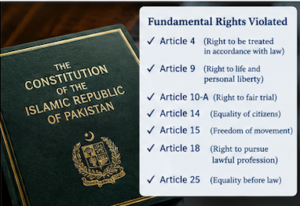
Consequently, a travel restriction is not merely an administrative inconvenience. Depending upon the circumstances, it may directly affect a citizen’s liberty, dignity, employment, business opportunities, family life, and economic interests.
The Supreme Court has previously recognized the importance of the right to travel abroad in Government of Pakistan v. Dada Amir Haider Khan (PLD 1987 SC 504) and Mian Muhammad Nawaz Sharif v. President of Pakistan (PLD 1993 SC 473). The same constitutional principle has subsequently informed the jurisprudence relating to ECL and PCL restrictions.
2. PCL Placement Cannot Be Based Merely on a Foreign Deportation
One of the most significant aspects of the recent Islamabad High Court decisions concerns citizens who are placed on the PCL merely because they were deported from a foreign country.
In Zia Ullah v. DG Immigration & Passports, the petitioner’s name had been placed on the PCL following his deportation from the United Arab Emirates. The respondents relied upon information received from foreign authorities and maintained that the petitioner had been imprisoned for violation of residency laws. The Court, however, found that the record did not contain any FIR, charge-sheet, conviction, inquiry report, or adjudication by a competent Pakistani authority establishing criminal culpability.
The Court therefore drew an important distinction between deportation and proof of criminal guilt:
Deportation, by itself, does not necessarily establish that a person has committed a criminal offence. A person may be deported for a variety of reasons, including immigration, residency, or administrative violations. Therefore, an executive authority cannot automatically convert the fact of deportation into a finding of criminal culpability and, on that basis alone, impose a serious restriction upon the citizen’s constitutional right to travel.
The same principle was emphasized in Khalid Awan v. Immigration & Passport Department. The Court observed that the respondents had relied upon a communication stating that the petitioner had been “jailed” and deported from the UAE, but no conviction, sentence, criminal proceedings, or judicial finding had been produced.
The Court rightly identified the evidentiary problem in such an approach: an expression such as “jailed” is insufficient to determine whether a person was convicted following a criminal trial, detained for an immigration violation, administratively detained pending deportation, or subjected to some other form of custody. Thus, an allegation or foreign administrative action cannot automatically be treated as a judicial determination of guilt in Pakistan.
3. Executive Information Is Not a Substitute for Judicial Determination
The judgments establish another important principle: where an executive authority seeks to impose a serious civil disability upon a citizen, it must possess material capable of objectively supporting that action. A mere communication, recommendation, or report may initiate administrative consideration, but it does not necessarily constitute conclusive proof of the underlying allegation.
In Zia Ullah, the Court held that the mere communication or report received from foreign authorities, without an independent inquiry or determination of guilt by competent domestic authorities, could not constitute sufficient lawful justification for depriving the petitioner of his fundamental right to travel.
In Khalid Awan, the Court held that the respondents had failed to establish the factual foundation necessary to justify the PCL restriction.
This does not mean that the executive is prohibited from acting upon information received from foreign governments or domestic agencies. Rather, such information must be evaluated, verified, and connected with a lawful statutory or regulatory ground before it can be used to impose a restriction affecting fundamental rights.
4. Rules 21, 22 and 23 of the Passport Rules, 2021 Are Not a Licence for Arbitrary Action
The respondents in the cases relied upon the Passport Rules, 2021, particularly Rules 21, 22, and 23, to justify the placement of petitioners’ names on the PCL. The existence of statutory or regulatory authority, however, does not mean that every exercise of such power is automatically lawful.
In Umar Sultan v. Federation of Pakistan, the Islamabad High Court examined Rule 22 of the Passport Rules, 2021 and considered the distinction between categories of the PCL. Rule 22 contemplates different categories and provides a mechanism for placement, retention, review, and removal of names.
The Court observed that the authority to exercise such powers must be traced to the authority contemplated by the Rules themselves. Importantly, the record did not demonstrate that the Federal Government had granted the requisite approval for placement of the petitioner’s name on the PCL as contemplated by Rule 22(1). The Court consequently held that the placement of the petitioner’s name on the PCL was without lawful authority.
Key Constitutional Takeaway: A statutory or regulatory power must be exercised strictly within the limits, procedure, and conditions prescribed by the law conferring that power. An administrative authority cannot enlarge its own jurisdiction merely by relying upon the general existence of governmental power.
5. Due Process and the Right to Be Heard
Perhaps the strongest common thread running through all three judgments is the requirement of due process. Article 10-A of the Constitution provides constitutional protection of fair trial and due process. Where an executive decision adversely affects a citizen’s civil rights or imposes a substantial disability, the affected person cannot ordinarily be condemned unheard.
In both Zia Ullah and Khalid Awan, the petitioners had not been issued a show-cause notice or afforded an opportunity of hearing before their names were placed on the PCL. The Court considered this omission constitutionally significant.
The principle of natural justice (audi alteram partem) requires, at a minimum, that a person facing an adverse administrative decision should ordinarily be informed of the case against him and given a meaningful opportunity to respond. The requirement becomes particularly compelling where the administrative action affects fundamental rights. The Islamabad High Court therefore rejected the notion that the executive can simply place a citizen on a restrictive list behind his back and subsequently justify the action through general references to policy or administrative information.
6. The Requirement of an Independent and Speaking Decision

The judgments also emphasize the necessity of application of mind. In Zia Ullah, the Court found that the restriction appeared mechanical and that the respondents had failed to demonstrate an individualized assessment of the petitioner’s circumstances.
This principle is fundamental to administrative law. A decision affecting constitutional rights cannot be based merely on the existence of a recommendation from another department. The competent authority must independently consider:
Factual Circumstances: The individual case details of the citizen.
Statutory Provisions: The precise legal or regulatory provision invoked.
Evidentiary Support: The factual material supporting the proposed restriction.
Gravity & Relevance: The seriousness and direct relevance of the alleged conduct.
Right of Reply: The explanation or defense offered by the affected person.
Necessity: The necessity of the travel restriction under the given circumstances.
Less Restrictive Alternatives: Whether a less restrictive measure could achieve the same governmental objective.
A mechanical endorsement of an agency’s recommendation is therefore insufficient where fundamental rights are engaged.
7. Proportionality as a Constitutional Requirement
The recent judgments bring the principle of proportionality into sharp focus. The State may possess a legitimate objective—for example, protecting national security, preventing abscondence in appropriate cases, safeguarding an investigation, or fulfilling an international obligation. But the legitimacy of the objective does not automatically validate every restriction adopted in its pursuit.
The restriction must remain proportionate to the objective.
In Khalid Awan, the Court expressly observed that executive action affecting fundamental rights must be reasonable, proportionate, and supported by objective material capable of judicial scrutiny. This means that the authority must establish a rational relationship between the alleged conduct and the restriction imposed.
A five-year restriction on international travel, for example, represents a substantial interference with an individual’s liberty and livelihood. Such a restriction therefore requires considerably more than an unverified allegation or a bare reference to deportation.
8. The Impact on Employment and Livelihood
An important dimension of the recent jurisprudence is the recognition that travel restrictions may have consequences beyond physical movement. For many Pakistani citizens, foreign travel is directly connected with employment, business, professional opportunities, education, and family obligations.
In Khalid Awan, the Court specifically recognized that placement on the PCL substantially impairs a person’s ability to obtain or utilize a passport and may consequently interfere with his ability to pursue lawful employment abroad. This brings Articles 9 and 18 directly into the constitutional analysis.
A citizen who possesses a valid foreign visa, employment opportunity, or lawful business engagement may suffer substantial economic prejudice when his passport is blocked or his name is placed on a stop list. Therefore, the State cannot treat a travel restriction as a purely technical administrative measure; its practical, real-world consequences must be factored into the decision.
9. Pendency of Criminal Proceedings Does Not Automatically Justify a Travel Ban
The Umar Sultan judgment is particularly relevant where authorities seek to justify travel restrictions on the basis of pending criminal cases. In that case, the respondents relied upon multiple FIRs registered against the petitioner. However, the record also showed that the petitioner had obtained pre-arrest bail and had joined the investigation.
The Court ultimately found the placement of the petitioner’s name on the PCL to be without lawful authority, particularly in view of the absence of the requisite approval contemplated under the Rules and the failure to afford due process.
The broader principle emerging from the judgment is that the mere existence of an FIR or criminal accusation cannot, by itself, eliminate constitutional protections:
An FIR is an allegation requiring investigation and adjudication; it is not a conviction. This distinction is vital because restrictions on travel should not become a mechanism through which an accused person is effectively punished before determination of guilt. Where the State seeks to prevent an accused from leaving the jurisdiction, it must demonstrate the lawful source of the power and satisfy applicable legal and constitutional standards.
10. Alternate Remedy Is Not an Absolute Bar to Constitutional Jurisdiction
Another significant issue addressed in Zia Ullah concerns the availability of an alternate remedy. The respondents argued that the petitioner could approach the Review Committee constituted under Rule 22(3) of the Passport Rules, 2021.
The Court nevertheless held that the existence of an alternate remedy does not constitute an absolute bar to constitutional jurisdiction where the impugned action is without lawful authority or is manifestly violative of fundamental rights.
An alternate administrative remedy is ordinarily expected to be exhausted before invoking constitutional jurisdiction under Article 199. However, well-established exceptions apply where the administrative action:
Is patently without jurisdiction;
Is taken without lawful authority;
Involves direct violation of fundamental rights; or
Suffers from an obvious jurisdictional defect going to the root of the decision.
Accordingly, a citizen whose name has been unlawfully placed on a stop list is not required to remain subjected to an unconstitutional restriction merely because an administrative review mechanism exists.
11. Federal Government Cannot Be Replaced by an Unauthorised Administrative Recommendation
The Umar Sultan judgment addresses the constitutional meaning of powers vested in the Federal Government. The Court relied upon authoritative precedents:
Controller General of Accounts v. Fazil Ahmad (2021 SCMR 800)
Government of Sindh v. Dr. Nadeem Rizvi (2020 SCMR 1)
Mustafa Impex, Karachi v. Government of Pakistan (PLD 2016 SC 808)
These rulings emphasize the legal significance of powers vested in the Federal Government. Where the law requires an action to be taken by a specified constitutional or executive authority, that requirement cannot simply be bypassed by an administrative recommendation from another department:
A recommendation is not an approval.
An implementing agency is not the competent authority.
An internal communication cannot replace a statutory order required by law.
This distinction safeguards citizens against the unlawful exercise of executive power by authorities lacking proper statutory jurisdiction.
12. Scope of Judicial Review of Travel Restrictions
The decisions demonstrate that the High Court will not merely examine whether an administrative authority possesses general power over passports or immigration. It will rigorously examine how that power was exercised in individual cases.
       ┌────────────────────────────────────────────────────────┐
       │             SCOPE OF JUDICIAL SCRUTINY                 │
       ├──────────────────────────┬─────────────────────────────┤
       │ • Statutory Jurisdiction │ • Opportunity of Hearing    │
       │ • Passport Rules Compliance │ • Application of Mind    │
       │ • Competent Authority Approval│ • Reasoned Decision    │
       │ • Evidentiary Foundation │ • Proportionality Test      │
       │ • Issuance of Notice     │ • Constitutional Right Audit│
       └──────────────────────────┴─────────────────────────────┘
This represents an important shift away from treating travel restrictions as matters exclusively within administrative discretion. Executive discretion remains available, but constitutional discretion is never synonymous with unfettered discretion.
13. The International Human Rights Dimension
The constitutional protection of movement finds strong support in international human rights instruments:
Universal Declaration of Human Rights (UDHR), Article 13: Recognizes freedom of movement and the right of everyone to leave any country, including their own.
International Covenant on Civil and Political Rights (ICCPR), Article 12: Guarantees the right to leave any country, subject only to restrictions that are provided by law and necessary to protect national security, public order, public health or morals, or the rights and freedoms of others.
These international norms reinforce the domestic constitutional requirement that restrictions upon movement must not be arbitrary and provide useful interpretive context when evaluating executive actions.
14. A Developing Rule of Law Standard
Taken together, Zia Ullah, Umar Sultan, and Khalid Awan establish a coherent 10-point judicial framework:
| No. | Principle | Summary |
| 1 | Constitutional Status | The right to travel is a valuable fundamental right requiring lawful justification. |
| 2 | Statutory Precision | The State must pinpoint the exact legal or regulatory authority invoked. |
| 3 | Competent Authority | Power must be exercised by the designated authority; recommendations cannot substitute for approval. |
| 4 | Evidentiary Basis | Restrictions must rest on credible material, not bare assumptions or allegations. |
| 5 | Deportation Distinction | Foreign deportation/detention does not automatically establish criminal guilt. |
| 6 | Procedural Fairness | Due process (audi alteram partem) requires notice and a hearing prior to placement. |
| 7 | Independent Assessment | Authorities must apply their mind individually rather than mechanically endorsing agency requests. |
| 8 | Proportionality | Restrictions must be no broader than strictly necessary to fulfill the objective. |
| 9 | Presumption of Innocence | Pending FIRs or criminal allegations do not convert an accused into a convict. |
| 10 | Article 199 Jurisdiction | Alternate remedies do not bar constitutional writs against void/unconstitutional acts. |
Conclusion
The recent decisions of the Islamabad High Court represent an important reaffirmation of the constitutional principle that executive convenience cannot prevail over the rule of law.
The State undoubtedly possesses legitimate powers to regulate passports, prevent unlawful departure in appropriate circumstances, and protect national interests. However, those powers must be exercised strictly within the framework of the Constitution.
The placement of a citizen’s name on the PCL, ECL, PNIL, or another restrictive list is not a routine administrative formality. It deprives individuals of the practical ability to travel, work, conduct business, pursue education, and exercise personal autonomy. For that reason, such action must be supported by lawful authority, credible material, procedural fairness, and proportionality.
The jurisprudence in Zia Ullah, Umar Sultan, and Khalid Awan collectively signals that courts will scrutinize executive restrictions on travel not merely for the existence of governmental power, but for the legality, fairness, rationality, and constitutional legitimacy of its exercise.

The jurisprudential message is clear: a passport may be regulated, but a fundamental right cannot be curtailed through an unexplained administrative process; a citizen may be subjected to lawful restrictions, but not to arbitrary executive disability; and the power of the State, however important, remains subject to the Constitution.